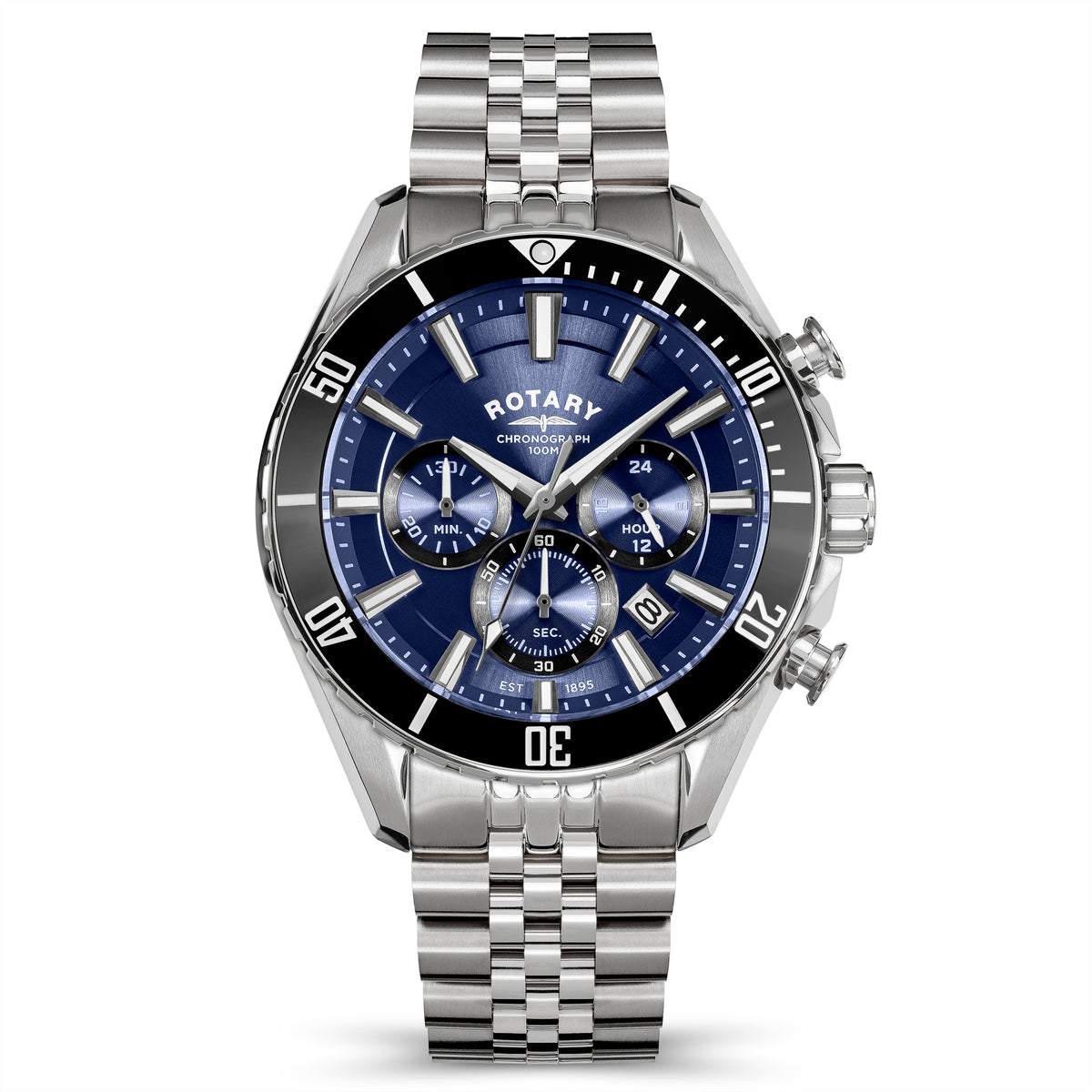
A chronograph watch is a wristwatch with an independently controlled elapsed-time function — essentially a stopwatch built into the watch. The normal hour and minute display keeps running while the chronograph can be started, stopped and reset using pushers, usually positioned beside the crown. That simple definition is the foundation for understanding almost every chronograph, whether it is quartz, mechanical, automatic or meca-quartz.
What makes a watch a chronograph?
The defining feature is the ability to measure an interval independently of normal timekeeping. The number of subdials does not decide it, and neither does a tachymeter scale. Some chronographs use two registers, some use three, some use digital displays and a few use only one pusher. A watch with decorative-looking subdials but no elapsed-time function is not a true chronograph.
On the familiar two-pusher layout, the upper button starts and stops the timer and the lower button resets the chronograph hands to zero. Specialised mechanisms can work differently: a flyback can reset and restart in one action, a rattrapante can split two timing hands, and a monopusher combines controls into a single button. Those are extensions of the basic idea rather than requirements.
The central chronograph seconds hand
One of the most common first-time-owner surprises is discovering that the long central seconds hand may remain parked at twelve o’clock. On many analogue chronographs, that hand belongs to the stopwatch rather than to ordinary timekeeping. Running seconds can be moved to a small subdial. This is why a stationary central hand does not necessarily mean that the watch has stopped.
What do the subdials show?
Subdials are registers for additional information. Depending on the movement, they can display running seconds, elapsed minutes, elapsed hours, fractions of a second or a 24-hour indication. Their position is not universal. Two watches with the same three-register visual layout can allocate completely different functions to those counters, so the manual or calibre documentation matters more than appearance.
How a chronograph measures elapsed time
Starting the chronograph engages a separate timing process. In a mechanical movement that process is coordinated by wheels, levers, cams and, on some movements, a column wheel. In quartz architecture, electronic regulation and stepper motors normally move the timing hands. Stopping freezes the measured interval for reading; resetting sends the relevant hands back to their zero position.
Quartz, automatic and meca-quartz chronographs
The word “chronograph” describes the complication, not the power source. Quartz chronographs use an electronic oscillator and battery or another electrical energy source. Automatic chronographs are mechanical watches wound partly by wrist movement. Manual chronographs require hand winding. Meca-quartz combines quartz regulation with a mechanical-style chronograph module or action, delivering some of the crisp engagement associated with mechanical timing at a more accessible ownership cost.
Chronograph vs chronometer
These words are often confused but answer different questions. A chronograph tells you that the watch can record elapsed time. A chronometer tells you about tested precision under a recognised regime. A watch can therefore be a chronograph without being a chronometer, a chronometer without being a chronograph, or both.
Why chronographs are associated with racing and aviation
Before smartphones and digital timing systems, a wearable stopwatch had obvious practical value. Racing, aviation, navigation, medicine, industry and sport all created reasons to measure intervals quickly. The visual language survived: high-contrast counters, prominent pushers, minute tracks and tachymeter scales remain central to chronograph design even when the watch is bought primarily for style.
What can you time in everyday life?
Cooking, exercise intervals, a commute, parking, a presentation, a break, a meeting segment or any short repeatable task can be timed from the wrist. The key limitation is the movement’s maximum recorded duration. Some chronographs count only seconds and minutes; others add an elapsed-hours register. If you intend to use the function rather than admire it, that capacity is worth checking before purchase.
Does a chronograph need a tachymeter?
No. A tachymeter is an optional scale used with elapsed seconds to calculate an average rate over a known unit. A clean dress chronograph can omit it completely and still be a chronograph. Conversely, a decorative scale does not create stopwatch functionality by itself.
Why chronographs often wear larger
The movement and display need space for extra functions, and the case must accommodate pushers. Even when the diameter is moderate, the watch can look larger because the dial contains more markings and subdials. When comparing models, use diameter as a starting point rather than the entire fit calculation.
How Chronographs.co.uk approaches comparisons
Chronographs.co.uk separates measurable product facts from editorial judgement. The catalogue data tells us the model reference, movement family, case diameter, dial colour, strap or bracelet material, stated water resistance and retailer offers that were present when the database was exported. Those fields are useful because they can be compared consistently across hundreds of watches. They do not tell us which watch is objectively “best”, and they do not prove sales popularity, ownership satisfaction or long-term reliability.
Where this guide ranks or recommends watches, the order is therefore an editorial shortlist built around the stated use case. We favour specification fit, clarity of purpose, useful dimensions, water-resistance headroom where relevant and the distinctiveness of the model within the current Chronographs.co.uk catalogue. We do not manufacture review scores, star ratings, sales volumes or customer testimonials. If a live retailer price is mentioned, treat it as a snapshot rather than a promise: prices, voucher codes and stock can change quickly.
What to check before you buy any chronograph online
Start with the exact model reference. Collection names are not precise enough because the same family can contain several dial colours, strap options, case finishes and occasionally different specifications. Next, confirm the case diameter and, if the manufacturer publishes them, the thickness and lug-to-lug measurement. Chronographs often look and wear larger than a simple three-hand watch because the pushers, subdials and bezel add visual mass.
Check the movement type and learn what every subdial does. A counter marked to 24 is often a day/night or 24-hour display rather than an elapsed-hours register. Then compare glass type, water resistance, bracelet or strap construction and warranty terms. Finally, compare retailer offers only after deciding on the exact watch. A discount is useful when it lowers the cost of the model you actually want; it is not good value if it pulls you toward the wrong size or specification.
A note on specifications, water resistance and real-world use
Water-resistance figures should be read as manufacturer ratings, not as a universal permission list for activities. A chronograph rated to 100 metres can be a much more practical sports watch than one rated to 30 or 50 metres, but that still does not automatically mean its pushers should be operated underwater. Unless the maker explicitly approves submerged pusher operation, use the controls only when the watch is dry. Seals also age, so periodic pressure testing is sensible if swimming matters to you.
Likewise, movement labels describe architecture rather than a complete quality verdict. Quartz can provide excellent everyday accuracy and low-maintenance ownership. Mechanical chronographs can make the movement itself part of the appeal. Meca-quartz combines quartz regulation with a more mechanically styled chronograph action. The right choice depends on what you value rather than on a simplistic hierarchy.
How to turn specifications into a better buying decision
A specification sheet is most useful when you convert every number into a question about your own routine. A larger case is neither better nor worse until you consider wrist size, sleeve clearance and the visual presence you prefer. More water resistance is valuable if the watch will be exposed to swimming or frequent wet conditions, but it may be irrelevant if you want a slim dress-led chronograph. A steel bracelet can feel reassuringly substantial, while leather can make the same diameter feel lighter and more traditional.
Use the catalogue as a filtering tool rather than as a substitute for judgement. Shortlist watches that meet your non-negotiable requirements, compare exact references side by side and then inspect manufacturer information for details the comparison database does not store, such as lug-to-lug length, thickness, calibre functions, battery life, service intervals, clasp adjustment and the precise purpose of each subdial. This layered approach is slower than choosing the first attractive dial, but it produces a far more defensible purchase.
It also makes future comparisons easier. Once you know that, for example, a 40–42mm case, at least 100m water resistance and a steel bracelet suit you, every new chronograph can be assessed against that personal baseline. The result is a buying process based on fit and function rather than marketing language.
Frequently asked questions
Is a chronograph the same as a chronometer?
No. A chronograph records elapsed time. A chronometer is a watch or movement that has met a defined precision-testing standard. A watch can be both, one or neither.
Do chronograph subdials all do the same thing?
No. Subdials may show running seconds, elapsed minutes, elapsed hours, fractions of a second or a 24-hour indication. Always check the calibre or model manual.
Should I leave the chronograph running all the time?
Usually there is no need. Continuous operation can increase battery use on quartz models and power consumption or wear on mechanical systems. Follow the movement maker’s instructions.
Can I press chronograph pushers underwater?
Not unless the manufacturer specifically says the watch is designed for that. A water-resistance rating alone does not guarantee safe underwater pusher operation.