Quartz, automatic and meca-quartz chronographs can all perform the same basic job, but they deliver very different ownership experiences. Quartz prioritises practical accuracy and convenience, automatic chronographs make mechanical engineering central to the appeal, and meca-quartz combines quartz regulation with a more mechanically styled chronograph action.
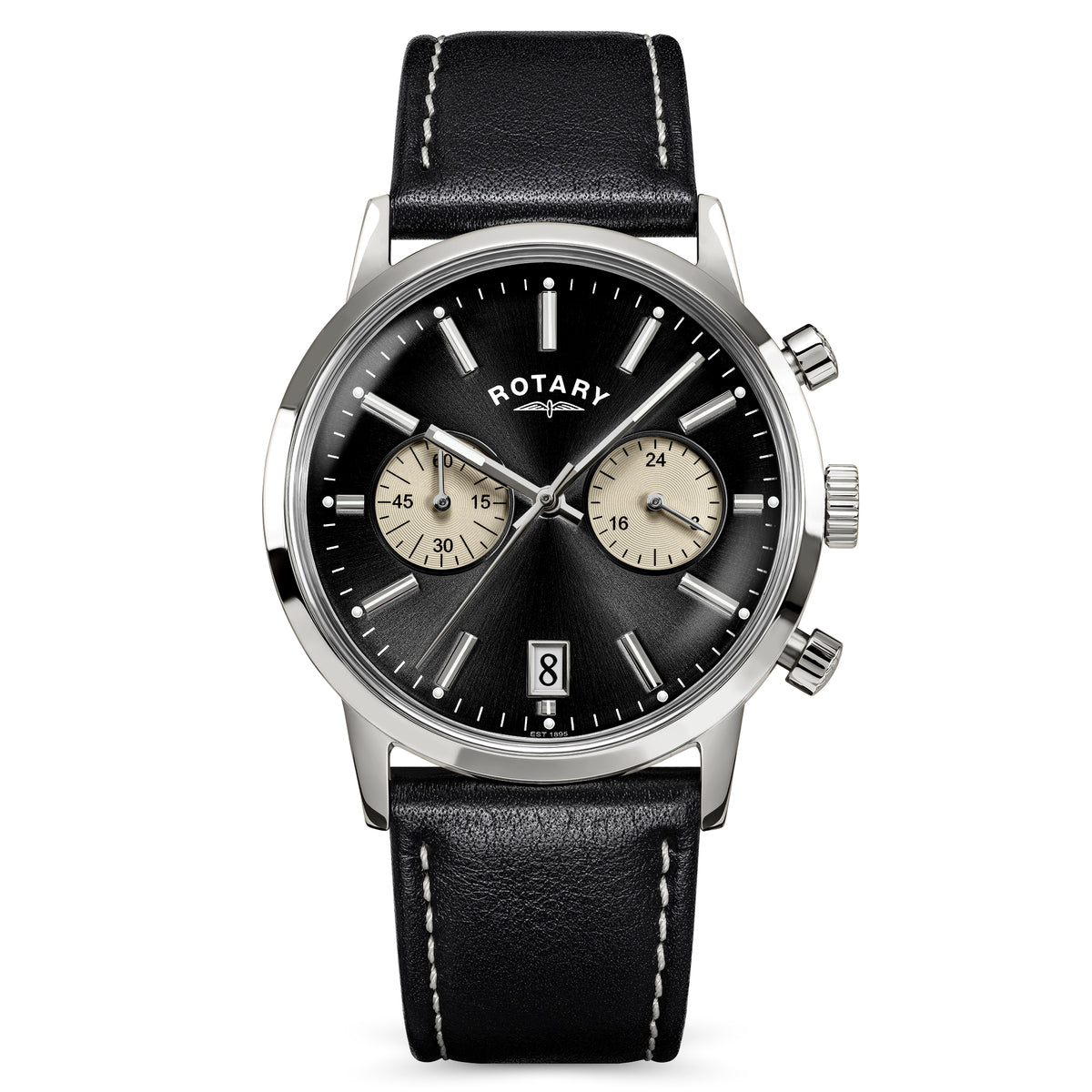
Quartz chronographs
A quartz chronograph uses an electronic oscillator to regulate time. Stepper motors commonly drive the hands and counters. The practical advantages are compelling: strong everyday accuracy, comparatively low purchase prices, simple battery-powered ownership and the ability to package several timing functions into a reliable movement. For many buyers, especially those who want a chronograph to wear rather than to study mechanically, quartz is the rational default.
Automatic mechanical chronographs
An automatic chronograph is entirely mechanical and uses a rotor to wind the mainspring as the wearer moves. Starting the chronograph engages an additional mechanical timing system. Enthusiasts may care about whether that system uses a column wheel or cam switching and about how the chronograph is coupled to the gear train. These watches can be fascinating, but servicing is typically more involved than replacing a quartz battery.
Meca-quartz chronographs
Meca-quartz is a hybrid concept. Quartz regulation handles timekeeping while the chronograph employs a mechanically influenced module or action. Depending on the calibre, this can provide a crisp pusher feel and a rapid reset that looks closer to a traditional mechanical chronograph. It is attractive to buyers who like the tactile character of a chronograph but want quartz convenience.
Which is most accurate?
In broad everyday terms, quartz regulation normally offers the strongest rate accuracy for the money. A high-grade mechanical chronograph can be extremely well regulated, but mechanical rate is affected by position, temperature, power reserve and movement condition. Meca-quartz inherits quartz regulation for normal timekeeping, so its ownership profile is closer to quartz than to a fully mechanical watch.
Which has the best pusher feel?
This is subjective and calibre-dependent. Traditional mechanical chronographs can deliver a beautifully engineered click, particularly with refined switching systems. Meca-quartz specifically appeals because it can provide a more mechanical-feeling chronograph action than basic quartz. A conventional quartz chronograph may have lighter pusher feedback, but there are many exceptions.
Which is easiest to maintain?
Quartz usually wins on simplicity. Batteries eventually require replacement unless the watch uses a rechargeable solar system, and seals should be checked when the case is opened. Mechanical chronographs need periodic servicing because lubricants age and the movement contains many interacting parts. Meca-quartz remains largely a quartz ownership proposition, although the chronograph module still has mechanical elements.
Which offers the best value?
Value depends on what you are paying for. If utility, accuracy and low fuss matter most, quartz is difficult to beat. If the movement itself is a major reason you collect watches, the higher cost of a mechanical chronograph can be meaningful rather than wasteful. If you want tactile character without moving into traditional mechanical pricing, meca-quartz can occupy an attractive middle ground.
How the Chronographs.co.uk catalogue illustrates the choice
The supplied database is heavily populated with quartz chronographs from fashion and Swiss brands, which reflects how common the technology is at accessible retail price points. Rotary’s 1895 references are specifically catalogued as meca-quartz, making them useful examples of the hybrid category. The lesson is not that one technology dominates; it is that movement type should be one of the first filters you apply.
What to ask before deciding
Do you want maximum convenience? Do you enjoy winding or the idea of an autonomous mechanical machine? Are service costs acceptable? Does a sweeping or snap-back timing hand matter to you? How often will you use the stopwatch? Answering those questions will usually narrow the movement choice before brand, dial colour or bracelet enters the discussion.
How Chronographs.co.uk approaches comparisons
Chronographs.co.uk separates measurable product facts from editorial judgement. The catalogue data tells us the model reference, movement family, case diameter, dial colour, strap or bracelet material, stated water resistance and retailer offers that were present when the database was exported. Those fields are useful because they can be compared consistently across hundreds of watches. They do not tell us which watch is objectively “best”, and they do not prove sales popularity, ownership satisfaction or long-term reliability.
Where this guide ranks or recommends watches, the order is therefore an editorial shortlist built around the stated use case. We favour specification fit, clarity of purpose, useful dimensions, water-resistance headroom where relevant and the distinctiveness of the model within the current Chronographs.co.uk catalogue. We do not manufacture review scores, star ratings, sales volumes or customer testimonials. If a live retailer price is mentioned, treat it as a snapshot rather than a promise: prices, voucher codes and stock can change quickly.
What to check before you buy any chronograph online
Start with the exact model reference. Collection names are not precise enough because the same family can contain several dial colours, strap options, case finishes and occasionally different specifications. Next, confirm the case diameter and, if the manufacturer publishes them, the thickness and lug-to-lug measurement. Chronographs often look and wear larger than a simple three-hand watch because the pushers, subdials and bezel add visual mass.
Check the movement type and learn what every subdial does. A counter marked to 24 is often a day/night or 24-hour display rather than an elapsed-hours register. Then compare glass type, water resistance, bracelet or strap construction and warranty terms. Finally, compare retailer offers only after deciding on the exact watch. A discount is useful when it lowers the cost of the model you actually want; it is not good value if it pulls you toward the wrong size or specification.
A note on specifications, water resistance and real-world use
Water-resistance figures should be read as manufacturer ratings, not as a universal permission list for activities. A chronograph rated to 100 metres can be a much more practical sports watch than one rated to 30 or 50 metres, but that still does not automatically mean its pushers should be operated underwater. Unless the maker explicitly approves submerged pusher operation, use the controls only when the watch is dry. Seals also age, so periodic pressure testing is sensible if swimming matters to you.
Likewise, movement labels describe architecture rather than a complete quality verdict. Quartz can provide excellent everyday accuracy and low-maintenance ownership. Mechanical chronographs can make the movement itself part of the appeal. Meca-quartz combines quartz regulation with a more mechanically styled chronograph action. The right choice depends on what you value rather than on a simplistic hierarchy.
How to turn specifications into a better buying decision
A specification sheet is most useful when you convert every number into a question about your own routine. A larger case is neither better nor worse until you consider wrist size, sleeve clearance and the visual presence you prefer. More water resistance is valuable if the watch will be exposed to swimming or frequent wet conditions, but it may be irrelevant if you want a slim dress-led chronograph. A steel bracelet can feel reassuringly substantial, while leather can make the same diameter feel lighter and more traditional.
Use the catalogue as a filtering tool rather than as a substitute for judgement. Shortlist watches that meet your non-negotiable requirements, compare exact references side by side and then inspect manufacturer information for details the comparison database does not store, such as lug-to-lug length, thickness, calibre functions, battery life, service intervals, clasp adjustment and the precise purpose of each subdial. This layered approach is slower than choosing the first attractive dial, but it produces a far more defensible purchase.
It also makes future comparisons easier. Once you know that, for example, a 40–42mm case, at least 100m water resistance and a steel bracelet suit you, every new chronograph can be assessed against that personal baseline. The result is a buying process based on fit and function rather than marketing language.
Frequently asked questions
Is a chronograph the same as a chronometer?
No. A chronograph records elapsed time. A chronometer is a watch or movement that has met a defined precision-testing standard. A watch can be both, one or neither.
Do chronograph subdials all do the same thing?
No. Subdials may show running seconds, elapsed minutes, elapsed hours, fractions of a second or a 24-hour indication. Always check the calibre or model manual.
Should I leave the chronograph running all the time?
Usually there is no need. Continuous operation can increase battery use on quartz models and power consumption or wear on mechanical systems. Follow the movement maker’s instructions.
Can I press chronograph pushers underwater?
Not unless the manufacturer specifically says the watch is designed for that. A water-resistance rating alone does not guarantee safe underwater pusher operation.
Is meca-quartz a mechanical watch?
Not fully. It uses quartz regulation for timekeeping and a mechanical-style chronograph mechanism or module, so it is best understood as a hybrid architecture.
Does an automatic chronograph need a battery?
A conventional fully mechanical automatic chronograph does not need a battery. It stores energy in a mainspring wound by the rotor and, depending on the movement, by the crown.