Chronograph case size should be chosen by wrist geometry and wearing preference, not by a universal “men’s” or “women’s” diameter. In the current Chronographs.co.uk database, recorded case diameters span a broad range, with a median around 44.0mm among products that include a numeric diameter. That makes it possible to compare compact, conventional and oversized chronographs using the same dataset.
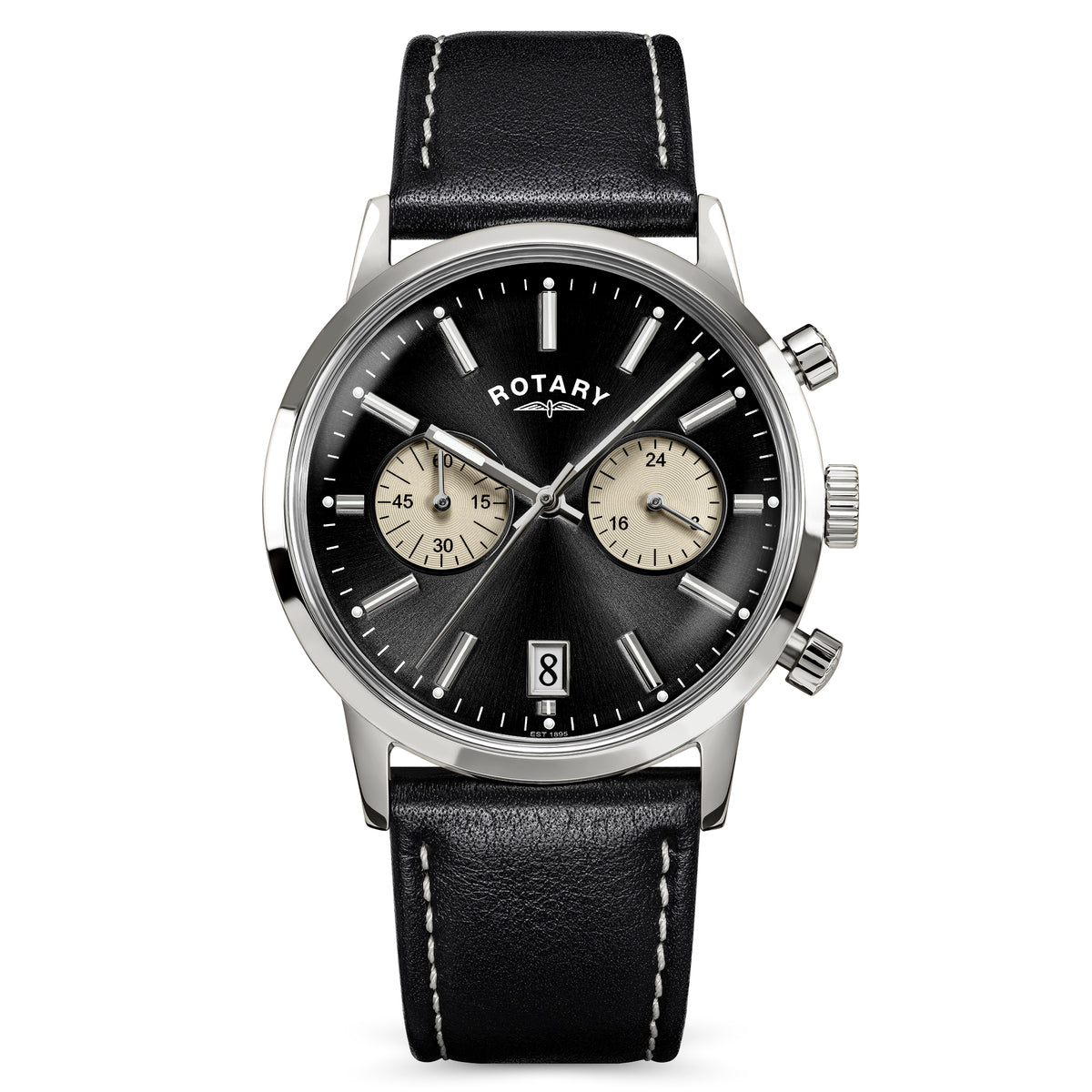
Why chronographs often feel larger than the number suggests
Pushers extend the visual width, subdials make the face appear busier and bezels can add mass around the dial. A 42mm chronograph can therefore feel more substantial than a 42mm three-hand watch. The opposite can also happen when a case has short lugs and a dark, visually compact dial.
Under 40mm: compact and increasingly distinctive
Chronographs below 40mm can suit smaller wrists, vintage-inspired tastes and buyers who want the complication without a dominant case. In modern catalogues they are less common than 42–45mm sport watches, so a genuinely compact chronograph can have a distinctive character.
40–42mm: the versatile middle ground
This range works well for many wrists because it offers enough dial area for readable counters without automatically becoming oversized. Rotary’s 40mm 1895 and Heritage references and 42mm Pilot/Apex models show how different styling can make nearby diameters wear very differently.
43–44mm: stronger wrist presence
Many Hugo Boss and Emporio Armani chronographs sit in this zone. It creates a modern, assertive look while remaining manageable for a wide range of buyers. Pay more attention to lug-to-lug distance and thickness as diameter rises, because those dimensions begin to determine cuff clearance and overhang.
45–47mm: intentionally large
Tissot sport chronographs and several fashion models occupy this territory. Buyers should expect a substantial visual footprint. This can be ideal for highly legible counters or a bold sports aesthetic, but it is worth comparing the watch against something you already own before ordering online.
50mm and above: oversized as a design statement
Diesel’s 51mm Mega Chief and 57mm Mr Daddy families demonstrate the extreme end of the catalogue. At these sizes, presence is the point. Comfort depends heavily on wrist shape, strap, case weight and how the lugs curve. They should not be chosen by diameter convention; they should be chosen because you specifically want an oversized watch.
How to measure your wrist
Wrap a flexible tape around the point where you normally wear a watch. Circumference is useful, but the flat width across the top of the wrist is more directly related to lug overhang. If possible, measure the lug-to-lug length of a watch you already find comfortable and use it as a personal benchmark.
Why lug-to-lug matters more than many buyers realise
Diameter measures the case from side to side, usually excluding crown and pushers. Lug-to-lug measures the span from the tip of the upper lugs to the lower lugs. A watch can have a moderate diameter and still wear long if its lugs project significantly. Unfortunately this field is not present in every retailer feed, so manufacturer specifications can fill the gap.
Thickness and cuffs
Mechanical chronographs can be thick because of their movement architecture, while even quartz watches can be bulky due to case styling. If you wear fitted shirt cuffs, thickness may determine daily comfort more than diameter. Look for side-profile photographs and the manufacturer’s thickness figure when available.
Bracelet end links can extend the footprint
Some solid end links articulate immediately; others project outward before the bracelet drops around the wrist. That changes the effective span. Leather and flexible rubber straps usually fall away more quickly, which can make the same case diameter feel smaller.
A better sizing rule
Rather than asking “what size should I wear?”, ask “what dimensions do I already enjoy wearing?” Compare a known comfortable watch against the chronograph’s diameter, lug-to-lug and thickness. This personalised reference point is more useful than gendered size charts or arbitrary wrist-size rules.
How Chronographs.co.uk approaches comparisons
Chronographs.co.uk separates measurable product facts from editorial judgement. The catalogue data tells us the model reference, movement family, case diameter, dial colour, strap or bracelet material, stated water resistance and retailer offers that were present when the database was exported. Those fields are useful because they can be compared consistently across hundreds of watches. They do not tell us which watch is objectively “best”, and they do not prove sales popularity, ownership satisfaction or long-term reliability.
Where this guide ranks or recommends watches, the order is therefore an editorial shortlist built around the stated use case. We favour specification fit, clarity of purpose, useful dimensions, water-resistance headroom where relevant and the distinctiveness of the model within the current Chronographs.co.uk catalogue. We do not manufacture review scores, star ratings, sales volumes or customer testimonials. If a live retailer price is mentioned, treat it as a snapshot rather than a promise: prices, voucher codes and stock can change quickly.
What to check before you buy any chronograph online
Start with the exact model reference. Collection names are not precise enough because the same family can contain several dial colours, strap options, case finishes and occasionally different specifications. Next, confirm the case diameter and, if the manufacturer publishes them, the thickness and lug-to-lug measurement. Chronographs often look and wear larger than a simple three-hand watch because the pushers, subdials and bezel add visual mass.
Check the movement type and learn what every subdial does. A counter marked to 24 is often a day/night or 24-hour display rather than an elapsed-hours register. Then compare glass type, water resistance, bracelet or strap construction and warranty terms. Finally, compare retailer offers only after deciding on the exact watch. A discount is useful when it lowers the cost of the model you actually want; it is not good value if it pulls you toward the wrong size or specification.
A note on specifications, water resistance and real-world use
Water-resistance figures should be read as manufacturer ratings, not as a universal permission list for activities. A chronograph rated to 100 metres can be a much more practical sports watch than one rated to 30 or 50 metres, but that still does not automatically mean its pushers should be operated underwater. Unless the maker explicitly approves submerged pusher operation, use the controls only when the watch is dry. Seals also age, so periodic pressure testing is sensible if swimming matters to you.
Likewise, movement labels describe architecture rather than a complete quality verdict. Quartz can provide excellent everyday accuracy and low-maintenance ownership. Mechanical chronographs can make the movement itself part of the appeal. Meca-quartz combines quartz regulation with a more mechanically styled chronograph action. The right choice depends on what you value rather than on a simplistic hierarchy.
How to turn specifications into a better buying decision
A specification sheet is most useful when you convert every number into a question about your own routine. A larger case is neither better nor worse until you consider wrist size, sleeve clearance and the visual presence you prefer. More water resistance is valuable if the watch will be exposed to swimming or frequent wet conditions, but it may be irrelevant if you want a slim dress-led chronograph. A steel bracelet can feel reassuringly substantial, while leather can make the same diameter feel lighter and more traditional.
Use the catalogue as a filtering tool rather than as a substitute for judgement. Shortlist watches that meet your non-negotiable requirements, compare exact references side by side and then inspect manufacturer information for details the comparison database does not store, such as lug-to-lug length, thickness, calibre functions, battery life, service intervals, clasp adjustment and the precise purpose of each subdial. This layered approach is slower than choosing the first attractive dial, but it produces a far more defensible purchase.
It also makes future comparisons easier. Once you know that, for example, a 40–42mm case, at least 100m water resistance and a steel bracelet suit you, every new chronograph can be assessed against that personal baseline. The result is a buying process based on fit and function rather than marketing language.
Building a shortlist from the Chronographs.co.uk catalogue
For a search around chronograph watch size guide, a useful shortlist should begin with facts that can be filtered consistently. The supplied database contains 613 product records across seven brands: Hugo Boss, Emporio Armani, Tissot, Michael Kors, Rotary, Diesel and Tommy Hilfiger. That breadth is valuable because it lets buyers compare very different design philosophies while using common fields such as movement type, case diameter, dial colour, strap material and stated water resistance.
Start by setting hard limits. If a watch above 44mm is uncomfortable, remove it regardless of brand prestige or discount. If swimming matters, remove low-water-resistance models and then verify the manufacturer’s guidance for the remaining references. If you want a bracelet, exclude leather-only configurations unless the lug design makes a suitable replacement straightforward. These filters turn hundreds of listings into a manageable set without relying on vague adjectives.
Next, separate facts from unknowns. The database can show a movement label, but a complete calibre analysis may require manufacturer documentation. It can show diameter, but not every record contains thickness or lug-to-lug length. It can record an offer price, but that price is time-sensitive. Good research does not hide those limits; it identifies them and then seeks the missing information from the appropriate source.
Finally, compare exact references rather than collection names. A single family may contain several dial colours and strap combinations. Reference-level comparison prevents the common mistake of reading a review of one variant and assuming every specification applies to another. This is particularly important for search and AI-generated summaries, where collection-level statements can be repeated without enough model context.
Frequently asked questions
Is a chronograph the same as a chronometer?
No. A chronograph records elapsed time. A chronometer is a watch or movement that has met a defined precision-testing standard. A watch can be both, one or neither.
Do chronograph subdials all do the same thing?
No. Subdials may show running seconds, elapsed minutes, elapsed hours, fractions of a second or a 24-hour indication. Always check the calibre or model manual.
Should I leave the chronograph running all the time?
Usually there is no need. Continuous operation can increase battery use on quartz models and power consumption or wear on mechanical systems. Follow the movement maker’s instructions.
Can I press chronograph pushers underwater?
Not unless the manufacturer specifically says the watch is designed for that. A water-resistance rating alone does not guarantee safe underwater pusher operation.